
There’s a version of science that gets all the attention: the flashy stuff, the headline-grabbing cure, the press conference. But some of the most consequential science happens quietly, in a plate the size of your palm, measured in nanograms per milliliter. That’s where the ELISA kit lives, and it deserves more credit than it gets.
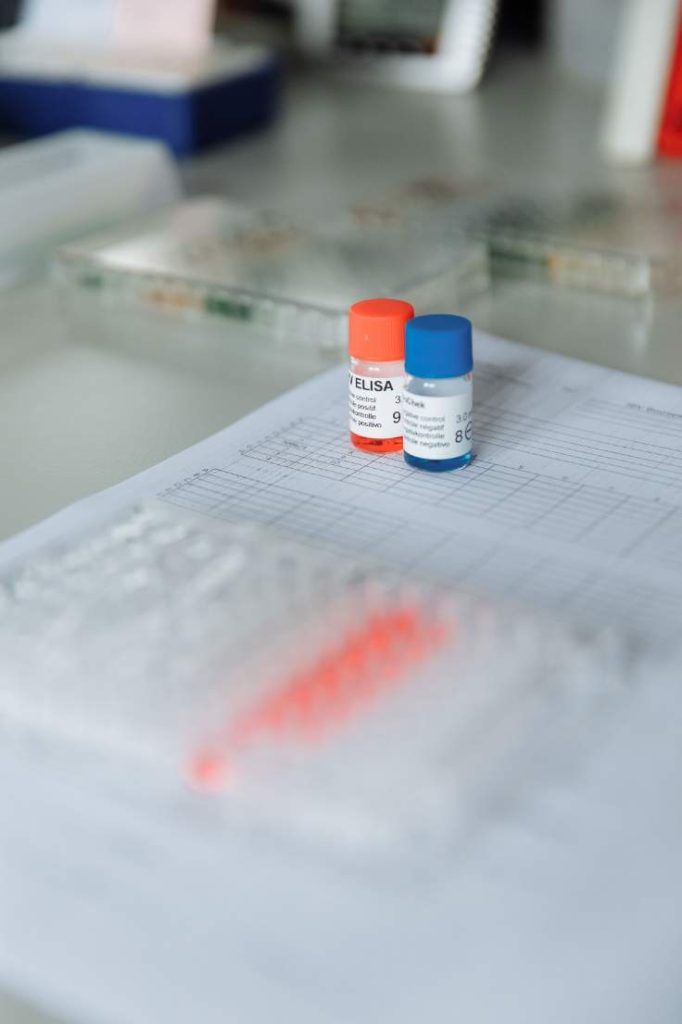
ELISA stands for enzyme-linked immunosorbent assay, and if that sounds clinical, the history behind it is anything but boring. In 1971, Eva Engvall and Peter Perlmann in Sweden, working alongside Anton Schuurs and Bauke van Weemen in the Netherlands, were trying to solve a problem that had frustrated researchers for years. Radioimmunoassays, the gold standard at the time, worked well, but they required radioactive isotopes. That meant special licensing, hazardous waste protocols, and equipment most labs couldn’t afford or justify. So, these researchers asked the question that drives every real innovation: is there another way? Spoiler there’s always another way.
There was. By tagging antibodies with enzymes instead of radioactive markers, they could trigger a color change when a target molecule was present. No radiation. No specialized disposal. Just a plate, a reagent, and a color shift you could read with the naked eye, or later, a simple spectrophotometer. It was cheaper, safer, and more accessible, and accessibility is always better.
This accessibility makes ELISA technology so quietly radical today. HGH ELISA kits, for instance, let researchers and clinicians measure human growth hormone levels with precision that once required equipment only a handful of institutions could afford. What used to be gatekept by expensive labs and specialized radioactive handling is now something a mid-sized research facility, or even a smaller diagnostic lab, can run on a Tuesday afternoon. That shift matters. It means growth disorders get caught earlier. It means that for those babies suffering, changes can be made and they can grow up in a body that more resembles their peers. It means endocrine research isn’t limited to the institutions with the deepest pockets. It means science that actually reaches people instead of circling a small, well-funded elite. And let’s be honest, in our world today this is becoming more and more a problem.
This is the part of innovation nobody puts on a poster. It’s as simple as a shade of blue that tells a technician something important. But the pattern is the same one that runs through every meaningful advance: someone looked at a barrier, whether it was radioactive isotopes or exclusive access, and refused to accept it as permanent. As I get older an dolder the more I realize that this is true innovation. Not the fancy-smanchy titles, or jargon. People, scientists who look at the world and say, “we can do better”.
So along with rubber gloves ELISA kits are often overlooked. But the care and adaptation deserve a second glance.